
Self Guided Tour
Explore at Your Own Pace
Step back in time on your own schedule with our new digital farm tour.
Sometimes the best way to experience history is to simply wander through it. If you are looking for a relaxing, family-friendly afternoon where you can set your own pace, our brand-new self-guided digital tour is the perfect way to explore Seager Wheeler Farm.
Forget about strict tour schedules or rushing to keep up with a group. Whether you want to let the kids burn off some energy in the open yard, or you want to spend an extra twenty minutes photographing the heritage orchards, this tour puts the history of the "Wheat King" right in the palm of your hand.
How the Digital Tour Works
A seamless, interactive experience straight from your smartphone.
We’ve made it easier than ever to connect with the deep roots of the Canadian prairies. There are no apps to download and no special equipment required!
-
Drop In: Arrive at the farm during our regular summer hours. (Remember, no online booking is required!)
-
Load the Tour: Simply scan the QR code at the Visitor's Centre or click the link below to open the interactive tour on your smartphone.
-
Walk & Learn: Follow the tour or paper map to our designated historical stations. At each stop, you can read fascinating stories, view archival photos, and even listen to audio guides as you take in the sights.
1

Start Here

This is a statue of Seager Wheeler – actual size. There is no picture in which he is not the smallest man. He was born in 1868 on the Isle of Wight off the south coast of England. At age 11 Seager stopped school to begin working odd jobs providing for his family. At age 15, Wheeler and some friends applied to join the Navy but Wheeler was denied. He was too short.
He wondered what he might do. His mother had letters from her cousin Gus Lammond homesteading at Clark’s Crossing north of Saskatoon who encouraged the Wheeler family to immigrate and join him. Wheeler, mom and sister Alic landed in Quebec in June of 1815 and by June 5 had made it by train to Moose Jaw.
Four days after arriving, Wheeler left mom and sister Alice and hitched a ride with freight wagons heading north to Saskatoon. About halfway there he was told the cousin had gone for supplies to Moose Jaw, so Wheeler turned around and went back. He spent the winter doing odd jobs.
In spring, he again found farmers from Saskatoon in Moose Jaw for supplies and walked with them the 180 miles (290 kms) to Saskatoon and Lammond’s homestead at Clark’s Crossing.
He quickly learned that his mom’s cousin didn’t know a lot about farming. Broad cast seeding meant birds got much of it. The ground wasn’t prepared well. The seed quality often had weeds mixed in and too often, frost damaged the crop before harvest.
Seager looked for ways to adapt to his new situation. He began working through his harvest to pick only the best seeds for the next year’s seeding. He pulled a grooved log over his prepared field to plant his seed and raked it in to prevent bird theft. And he planted trees around his acres to slow the cold wind.
Even though he was joined by his brother Percy, Wheeler had some harsh years. He had fallen through the ice a couple of times crossing the river to his post office, store and market in Aberdeen. During a break in the harvest of 1886, his harvest crew suggested that he and Percy move to Rosthern. The land was better and access to rail and markets was much easier. Percy moved after harvest. Wheeler and his mother moved to Rosthern in the spring of 1897. His homestead, a 197-acre quarter was located next to his brother Percy’s.
Please proceed out the door towards the Carragana bushes and maples at Stop #2
2
Maple Grove Farm

You are standing in what Wheeler called “Maple Grove Farm”. This path lined with hardy Manitoba maples was the original driveway leading to the road. Like every other settler coming to the prairies, Seager, Percy and their mom needed to learn how to live in their new environment. Even if this was better soil and he had better access to markets how did he, a new settler learn to live here. Many settlers failed.
He faced cold – we have only a 100-day growing season between frosts. It’s dry – we only get an average of 35 cm (14 inches) of precipitation per year. It’s often very windy. There was a very limited infrastructure. And many early settlers were alone. An 19th century explorer, John Palliser didn’t think the prairies could ever support agriculture.
Wheeler used some key strategies. He could:
· Change the environment
· Adapt to the environment
· Move to a better environment
· Come with help
Coming to the Rosthern area was obviously moving to a better environment. Adapting to his situation he had already started at Clark’s Crossing by improved planting methods and seed selection. There too, he tried changing the environment by planting a shelter belt of hardy trees. And he came with his mother and his brother Percy.
Those strategies continued at Maple Grove Farm. When he came here, there were no trees. None. He had to travel 4 kms to the river to find trees big enough with which to build. All the trees around here are planted – the Manitoba maples of course, which gives the place its name.
But also, these carraganas, an import from Mongolia in the 1880s. By 1920, They created shelterbelts so that early farms would have protection from wind. They helped to divide property lines. They created habitat for birds and shelter for wildlife. They made barriers and enriched the soil with their nitrogen fixing. They helped prevent soil erosion. They kept snow from drifting across the roads in days when people still traveled by horse and buggy.
They are basically indestructible. From semi-arid and almost desert conditions, the caragana can endure intense heat, intense cold, and requires no care once established. It can endure crowding, extremely poor soil, browsing animals, and extreme neglect.
If you’re a prairie kid, you may remember the carragana hedge around your school yard – during recess in June, you could run to eat the showy yellow blossoms. Later in the season, you could make whistles from the pods.
Please continue toward stop 3, the plow that is near your end of the driveway.
3
The Plow

At Clark’s Crossing, Wheeler initially used grooved logs as farming equipment for more consistent seeding and more dependable crops. But a plow like this one was much better at preparing the land. Wheeler quickly learned, however, that while the plow was good to open up the soil, and it was effective at turning sods to create the soddy where he and his mother lived, it dried the soil too much to be used every spring.
One of Wheeler’s environmental adaptions looked for better ways to prepare the soil for seeds. You will see some of those later in the tour.
Head to stop 4.
4
The Oak and the Jackpine Tree

Perhaps challenging the environment should be added as another of Wheeler’s adaptions. That is exemplified through the Burr oaks and the Jack pines planted by Wheeler close to 100 years ago. Neither is native to this area. Burr oaks grow naturally in the Qu’Appelle and south eastern Saskatchewan. The Jack pine is natural in our northern forests. Wheeler had a number of these experiments to find ways prairie farmers could enrich their lives and their yards.
Another notable environmental challenge is the One Seeded Hawthorn. If you look past the corner of the house across the lawn, you can see it. It comes from England. Here, it is very much out of its typical growing environment yet it is flourishing.
Wheeler challenged his environment to find what could be successfully grown here. These trees are an example of his success.
Head to stop 5
5
The 1925 House
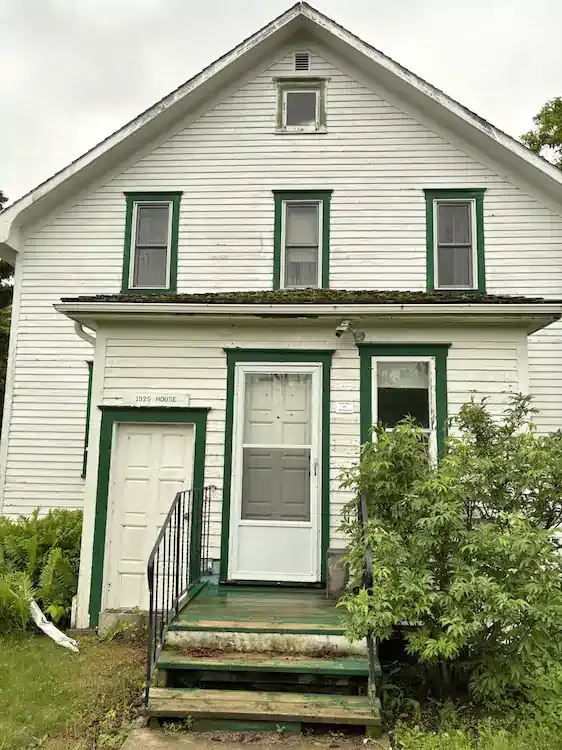
The 1925 house, an Eaton’s house, was built for Wheeler and his family. Like a modern component-built house, Seager and Lillian ordered the house in pieces from the Eaton’s catalogue for $5000. He hired Rosthern carpenter Charles Wilker to put the pieces together.
The house had one feature that was unusual for the 1920s -- a bathroom with a flush toilet. It is furnished very much as it was when the Wheelers lived here – all the chairs and rocking chairs are from Wheeler’s time. Note the family picture on the pump organ.
A balcony opened up from the master bedroom on the second floor. From there, Lillian Wheeler could see where Seager was working in the fields.
6
The Ice House and Smoke House

Living on the prairies needed adaptations in more areas than agriculture. How to keep food safe with no electricity – no deep freezers or fridges. You could “can” or “bottle” food – fruit, vegetables and even fish and meat and make pickles or sauerkraut. Lillian Wheeler would store quart jars of canned produce on shelves in her basement.
Or, you might use an icehouse. If you open the door of the Ice House, you will see a big ice saw. Some time in late December or January, Wheeler and other farmers would travel to the river, saw through the thick ice, pick up the chunks and place them on the sled to be brought to the icehouse. There it would be stored in a pit – the area painted red on the floor of the ice house would have been a pit about 5 feet deep. There, the ice would be stored with layers of straw between and insulating the chunks and kept into early fall. Mrs. Wheeler would come to the ice house, chip out what she needed and take it to the ice box in her kitchen.
Behind the ice box is the smoke house. Some time in late fall, homesteaders might have a butchering bee, gathering a group of neighbours or family to slaughter chickens, or a pig or a cow. The meat was often ground and stuffed into sausages or cut into hams or bacon and then salted and smoked over a slow smoky hardwood fire to cure. It would then keep without spoiling, especially in the cold weather which followed.
Please head past the demonstration beds to the orchard to learn about Wheeler’s cereal and horticulture trials.
7
The Demo Beds

The demonstration beds: The three southern most beds are planted with a variety of heritage peonies from the Saskatchewan Horticultural Society – some are very old varieties. If you’re here in June, you may see them in gorgeous bloom. We have a catalogue should you wish to buy peonies. They are $30 a root.
There is also a bed of day lily varieties and a herb garden. Other beds may be filled with a variety of vegetable trials.
8
The Cereals

If you walk through the orchard gates and down the path, you’ll come to the main cause of Wheeler’s renown – his prize-winning wheat, oats and barley that he developed which made agriculture on the prairies possible. You will see examples of his Marquis, Kitchener, and Red Bobs wheat, Victory oats, OAC21 and Canadian Thorpe barley.
After moving from his Clark’s Crossing homestead to this land, Wheeler continued his practices of looking for the best seed and thinking about how best to prepare his soil. In 1908, he met with L.H. Newman, the secretary of the Canadian agricultural experimental stations from Ottawa on a visit to the Rosthern station. He gave Wheeler a lesson on scientific seed selection & wheat genetics, planting individual rows to select the best seed heads. At the 1910 seed fair in Regina, Wheeler’s version of Preston wheat won first prize.
Newman was impressed by Wheeler and recommended to Dr. Saunders the head of the experimental stations that Wheeler was good candidate for to help with the development of Marquis, a wheat that was earlier to ripen than previous varieties.
Marquis was a cross between Hard Red Calcutta and the most commonly grown variety Red Fife. In the spring of 1911, Wheeler received 5 pounds of the cross which he planted in rows as you see.
When Newman came to inspect, he urged Wheeler to enter his version of Marquis in seed fairs. Wheeler did, winning first prize in the Regina and Calgary fairs. Newman then suggested that he send his sample to the New York exposition.
An American railroad company had put up a prize of $1000 in gold coins for the best bushel of hard red spring wheat in the United States. The president of the Canadian Pacific Railway challenged the Americans to make that a prize for the best wheat in North America. The Americans refused. So, the CPR offered that prize --$1000 in gold for best bushel of hard red spring wheat in North America.
On the late evening of November 5, 1911, Wheeler and his wife Lillian were sitting in their kitchen wondering how they were going to pay the bills – money still owed on their homestead, and for equipment. A knock on the door turned out to be a messenger from the telegraph station in Rosthern saying that Wheeler had won. You can see pictures of Wheeler and his prize in our reception centre.
Marquis has left a permanent legacy. Virtually every wheat variety produced in Canada over the past 100 years traces back to crosses made with Marquis. The highest priced wheat class on the world market today is the hard red spring wheat from Canada. Marquis has had a similar influence on the economies, grain industry and varietal improvement programs in the US, Argentina and Australia.
In 1914 and 1915-Wheeler again won best wheat in North America with his version of Marquis and again in 1916 with Kitchener and again in 1918 with Red Bobs. He was the Wheat King with 5 titles to his name.
9
The Orchard

While Wheeler was initially most well known for his work developing cereals that grew well on the prairies, he also worked at developing hardy horticulture species for shelter belts like the Siberian Silver Leaf Willow and Wheeler Poplar, and for fruit -- Saskatchewan Crab Apple, the Prolific and Cherry Plum Hybrids, and the Advance Sand Cherry. He also dabbled in vegetables developing the Gold Nugget potato.
Through studying his environment, he found that native Saskatchewan fruit all grew on bushes, not trees. So, except for apples, Wheeler focused on developing bush fruit. At one point he had the largest orchard nursery in the province. He became as well known selling his horticulture products as for his cereals.
While all of Wheeler’s fruit varieties have been lost to time, we keep his vision alive here with our cooperation with the U of S horticulture department. We grow sour cherries, saskatoon berries, raspberries, haskaps, blueberries, and dwarf rooted apples. Please feel free to pick and eat some of what’s ripe.
If you’ve come in May, you may see our many fruit species in fragrant bloom. In later months you may be here to share in our fruit harvest – haskaps in mid-June, saskatoons in mid-July, and sour cherries in early August. Our apples ripen from mid August to mid-September. Check our Facebook page for news about picking times.
10
The Machinery Row

The machinery down the path to the granary showcases a variety of farm equipment used by frontier farmers like Seager Wheeler. These tools helped Wheeler to change the environment to better grow his crops and take care of them. Please take a moment to read the description on the signs next to the equipment.
You will see:
a feed chopper used to break up stooks of oats into smaller pieces to feed cattle
packers were pulled behind seeders to pack the soil around seed for better germination
binder cuts the ripe grain and ties it into a sheaf. The sheafs were stacked in the field in stooks to dry and wait to be taken to a threshing machine.
Tractor (I need to get some specifics on this),
Digger would be pulled by a team of horses. One operator would handle the horses and another would man the scoop – digging it into the ground, skidding it out of the hole to dump out side. Very hard work
Caboose on runners pulled used for transport in winter. If you look inside, there’s a stove to keep passengers warm. The back would be covered with straw over stones warmed in the oven for the trip.
11
Soddie and 1908 House

Look across to the center of the farmyard to find the 1908 house and the plot where the soddy was built. These homes were the early additions to the homestead that Wheeler had built. The soddy was an ingenious settler adaption to prairie environment. With no lumber to build and trees 4 kms away at the river, Seager turned over the prairie sod with his plow, cut the turfs into bricks to build the foot thick walls over a frame of poplars cut at the river. It was warm and wind proof. Wheeler built it for himself and his mother.
When lumber became available, Wheeler and his hired hand build the 1908 house. It was a family home that housed both Wheeler’s family and that of his hired man until the 1925 house was built.
12
The Granary
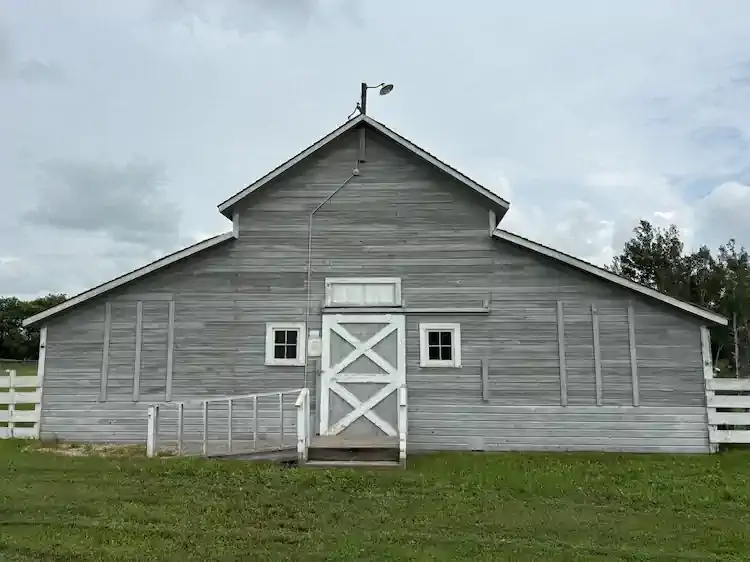
After winning so many prizes for wheat and other cereals, Seager was famous. Farmers all over North America were asking for those seeds to plant in their own fields. He had begun his processing by hand, separating seeds good from bad to for the best crops. With the many requests, that quickly became unworkable.
This seed cleaning plant and granary was Seager’s answer. The central isle has three sorting machines. The first two were existing technology, a sizer and a fanning mill. The third was Wheeler’s conception. By the end of the process, the seeds that came out were all the same size and weight. All the chaff, broken seeds and weed seeds were removed. You can see bags of Marquis wheat on a wagon by the door.
Wheeler was the “ideas man” of the operation but it was Percy who actually figured out the construction, bringing Seager’s idea to life. The machines were powered by two 6 ½ horsepower stationary engine and produced 10-15 bushels an hour. This machine helped Seager Wheeler manage his marketing and seed distribution. The machine still runs today! Ask a staff member to turn it on for you!
The “rooms” off the central isle were the grain storage bins. Now you will find seed samples and other equipment used on the farm.
Next head to the barn blacksmith shop.
13
Blacksmith Shop

At a time when settlers had to go a long way to find someone able to repair equipment, being able to do your own simple smithing was important. Even to travel the 6 km to Rosthern for repairs would have been a day long trip – and Wheeler would need to pay for the work. Here Seager or Percy or the hired hand could repair or even make most of what they needed. The blacksmith shop is still able to be worked. The forge, bellows and press drill can still do their jobs.
14
The Barn

This barn held Wheeler’s horses and cows. Most of Wheeler’s neighbours would have shipped cream to the creamery in Rosthern as a source of cash. Wheeler didn’t. His space for cows meant just enough milk for his own and hired hand’s families. Most of the barn space was for his horses which pulled his field machinery. Much of the equipment you will find in here was used for the care of the animals. Note the names of Wheeler’s horses painted above the stalls.
15
Seed Drills

We have two examples of Wheeler’s seed drills. The newest one from the 1920s is between the barn and the blacksmith shop. His first seed drill from1905 sits next to the water feature visible from the tea room. Wheeler’s philosophy was, “The best seed, best cleaned, best prepared soil, best seeding practice.” These drills, along with the packers you’ve already seen are his commitment to best seeding practice. Much better than broadcast seeding, better than other seeders of the time, these placed the seeds at the most effective spacing and depth for best germination.
16
The Plaque
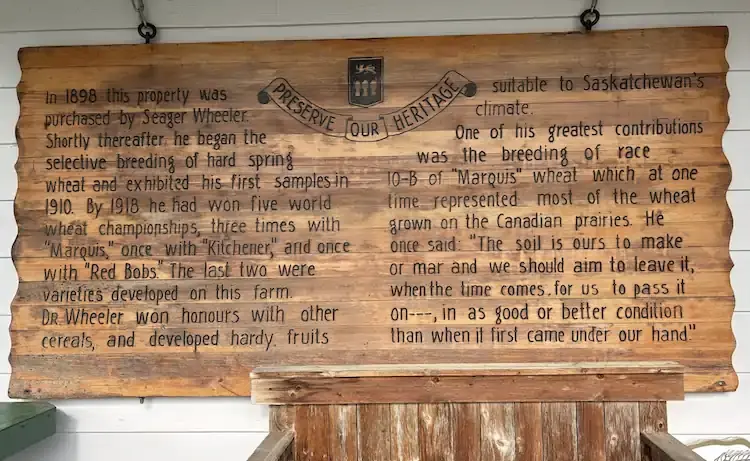
Our last stop. This plaque sums up Wheeler’s achievements. By the time he had won his fifth “Best Wheat in North American” prize, he and his seeds, and his horticultural contributions were much in demand. His 1919 book, Profitable Grain Growingtaught many how to farm on the prairies. Wheeler kept up a voluminous correspondence and wrote many articles for farming magazines. At a time when the prevalent attitude to the soil was to mine it, Wheeler looked to preserve and build it, summed up in his 1919 comment at the bottom of the plaque, “The soil is ours to make or mar, and we should aim to leave it when the time comes for us to pass it on, in as good or better condition than when it first came under our hand.”
Rosthern’s Wheat King had an enormous influence on prairie agriculture and settlement recognized in 1920, with an honorary Doctor of Laws degree granted by Queens University in Kingston.